Advertising and Ephemera
Advertising Tins and Trade Signs
Date advertising tins, signs and displays by lithography, brand and condition, and spot reproductions before you pay for one.
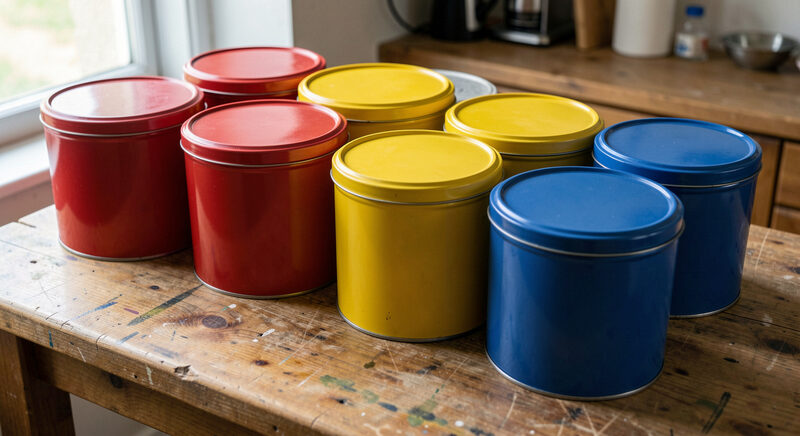
How advertising tins were made
Tins were made by shaping thin sheet metal and decorating it, and the way that was done changed over time. Early tins were built from separate pieces cut, folded and soldered by hand, with the decoration printed on flat sheets of metal that were then formed and joined. This is why an early tin often shows its seams on the outside, why its lid fits with a small looseness, and why the picture can be slightly out of line with the shape of the tin.
Later tins were stamped and rolled in one piece, with regular seams and a tighter, more uniform fit. The decoration was printed by methods that produced flat, even colour rather than the deep, layered colour of early lithography. A collector does not need to name every method, but should be able to see the difference between hand work and machine work, because that difference is the first dating signal and the hardest one to fake.
Reading the construction
Turn a tin over before you look at its front. The seams, the base, the lid and the inside carry more honest information than the picture. Hand soldered seams are uneven and show the marks of the iron. Machine seams are regular and often lock together in a way that hand work cannot. The base of an early tin may carry the marks of the press or the name of the maker. The inside may show the original surface, untouched by display, which is useful when the outside has been polished or repainted.
The lid is a small study of its own. An early lid sits by gravity, with a little play, and its rim may be slightly uneven. A later lid snaps or fits tightly, because it was made to a machine tolerance. A lid that fits a tin too well, on an object whose decoration looks old, is a reason to look again.
Reading the printing
The printing is the second dating signal and the one collectors learn to read most quickly. Early lithography has a softness at the edges of the colours, a depth that comes from layers of ink, and often a small signature or a printer's mark that names the firm that made the image. Later printing is flatter and more regular, and the colour sits on the surface rather than in it. A reproduction printed from a photograph of an old tin has a particular flatness, and its lines are either too sharp or slightly blurred in ways that the original never was.
Look at the paper or metal under the image where the surface is worn. A genuine old surface, worn through use, shows the metal or the paper beneath in a way that follows the pattern of handling. A reproduction aged by hand shows wear in the wrong places, often in the corners or the middle, rather than where a hand would actually have held it. The advertising and ephemera guide sets out the whole field, and this page continues with signs and reproductions.
Signs, and how they were hung
Signs carry their own clues in the way they were meant to be displayed. A sign with a hanging hole was meant for a wall or a window. A sign with a fold along one edge was meant to sit on a counter or a shelf. A sign in a wooden frame was made for a particular wall or a particular shop. These practical features date a sign as much as its picture, because the way a shop displayed advertising changed with the shop itself.
The back of a sign is often more informative than the front. Makers stamped their names, and sometimes their addresses, on the reverse. Signs that were printed in several layers for different customers may show an earlier image beneath a later one, which places the sign in a sequence. Where a sign has been cut down to fit a frame, the cut edge tells its own story, and a sign that has lost part of its image is worth less than a complete one, though it may still be worth keeping.
Spotting a reproduction
Reproductions are everywhere in this field, and most of them fail on a small number of points. The metal is too thin or too thick. The colour is too bright, or the image is too clean. The wear is in the wrong places. The age of the surface does not match the age of the printing. A maker's mark is missing where one would be expected, or present where the object never carried one. A slogan dates the object to one period while the construction dates it to another.
The collector's defence is to read the object in the order this page has set out: construction first, then printing, then wear, then marks, then brand. An object that passes all five readings is likely to be genuine. An object that fails one of them should be bought only as a reproduction, and at a reproduction's price. It also helps to know the brand, because a slogan or a product name sets a window that a reproduction often breaks.
Brand and slogan dating
Brands are a quiet but powerful dating tool. A firm that changed its name, a product that was renamed, or a slogan used for only a few seasons all pin an object to a period. The collector who keeps a simple file of brand histories, gathered from catalogues and reference books, will date finds that others cannot. Where a brand is unknown, the printing and the construction still carry the answer, and the two together rarely lie.
The reference bodies for this field, including the Antique Advertising Association of America at antiqueadvertising.com, publish material that helps collectors build that file. Read the advertising and ephemera guide for the families of printed advertising, and keep this page beside it when you are buying tins and signs.