Smalls and Sporting
Antique Medicine Bottles
Read antique medicine and pharmacy bottles by colour, lip and embossing, and learn what old labels and contents can tell you.
Why medicine bottles are collected
Medicine bottles are collected because they are beautiful, because they are affordable and because they are a record of a world of cures and remedies that has almost disappeared. A bottle may carry the name of a maker, a town and a claim, and together those details open a small window on the trade of its day. Bottles also come in a range of colours and shapes that make a shelf of them a pleasure to look at.
The field is friendly to the new collector because the objects are common and the reading is learnable. A collector can start with a handful of bottles found in an old shed and build a method from there, and the method will serve for every bottle they meet afterwards.
Colour and glass
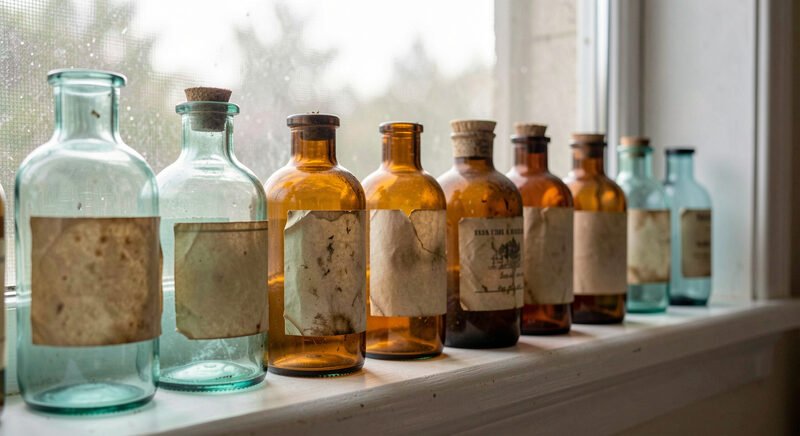
The colour of a bottle is the first thing to read. Early bottles were made in colours that came from the material itself, from the pale aqua of common glass to the deeper greens and ambers of bottles made for light sensitive contents. Clear glass became common later, as the making of glass improved. The colour of a bottle is a rough guide to its period, and it is also a guide to what the bottle held, since amber and dark glass protected medicines from light.
Some colours are rare and some are common, and the difference matters. A bottle in an unusual colour is a find, while the same shape in the common aqua is an everyday object. The collector should also look at the glass itself for bubbles, for the marks of the mould and for the sheen that comes with age, since all of these are part of how the bottle was made.
Shape, lip and construction
The shape of a bottle follows its use. A medicine bottle might be a simple cylinder, a paneled form, a flask or an oval, and each shape belongs to a period and a purpose. The lip, where the cork sat, is one of the most reliable dating features of all. An applied lip, formed by adding a ring of glass to the neck, belongs to an earlier period and shows the marks of the tool. A tooled lip, shaped with a tool, belongs to a later period. A machine made lip belongs to the twentieth century and is the latest of the three.
The way the bottle was made also dates it. Early bottles were blown into a mould and finished by hand, so they show a pontil mark on the base where the bottle was held, and their shape is slightly uneven. Later bottles were made by machines that produced a regular shape and a smooth base. The collector who learns to read the base will date a bottle almost at a glance.
Embossing and labels
Embossing, the words raised in the glass itself, is the clearest evidence a bottle can carry. A bottle embossed with a maker's name, a town and a product tells its own story and can often be dated from trade records. The style of the lettering is a dating signal in itself, since the fashion in type changed over the years, and the layout of the words on the panel follows the fashion of the trade.
Paper labels are rarer and more fragile than embossing, and a bottle that has kept its original label is a special object. Labels carry the product, the maker, the dose and sometimes a claim, and they should be read carefully and photographed. A label also carries a warning: a bright, clean label on an old bottle may be a reproduction, and a label that has been applied to the wrong bottle is a common fault. The collector should compare the label with the bottle and with the embossing, and should be suspicious when the three do not agree.
Contents and safety
Some old bottles still hold their original contents, and this is where a collector must be careful. Old medicines may contain substances that are dangerous, from heavy metals to alcohol and worse, and a sealed bottle should never be opened to smell or to taste it. The contents of a bottle are best left sealed, and the bottle kept out of reach of children and away from heat. The value of a bottle lies in the bottle, not in what it holds, and there is no reason to open it.
A bottle with a dried residue can be cleaned with care, but the cleaning should not remove the patina that comes with age. A bottle that has been polished to look new has lost part of its history, and the collector should prefer a bottle with honest age over one that has been made bright.
Display and storage
A shelf of bottles is best kept out of direct sun, which can fade labels and turn some glass purple over the years. Bottles should stand upright and be spaced so that they do not knock together, and the shelf should be away from damp, which can loosen labels. A collector who wants to show the colour of the glass can backlight a shelf, but should keep the light away from any paper label, since light is the enemy of paper.
The smalls and sporting guide on this site sets out the whole field of small objects, and the page on collecting Victorian hatpins shows how another family of smalls is read by material, marks and period. The Federation of Historical Bottle Collectors is the reference body for this field: fohbc.org.