Antique Clocks
How to Date an Antique Clock
Read a clock's dial, movement, case and maker marks to place it in time, and learn which features date a clock most reliably.
Why a clock has no single date
A clock is rarely made all at once. A case may be built by one workshop, a dial painted by another, and a movement bought in from a third. Clocks were also repaired, updated and rebuilt across their long lives, so a single object can carry the marks of several decades. A collector who wants one date for a clock is often asking the wrong question. The better question is which part of the clock is oldest, and how the other parts relate to it.
This is why the reading order matters. The dial, the movement and the case each speak in their own language, and the honest answer is usually a range rather than a year. A clock dated to a range, with the reasons given, is more useful than a clock dated to a year on a hunch.
Start with the dial
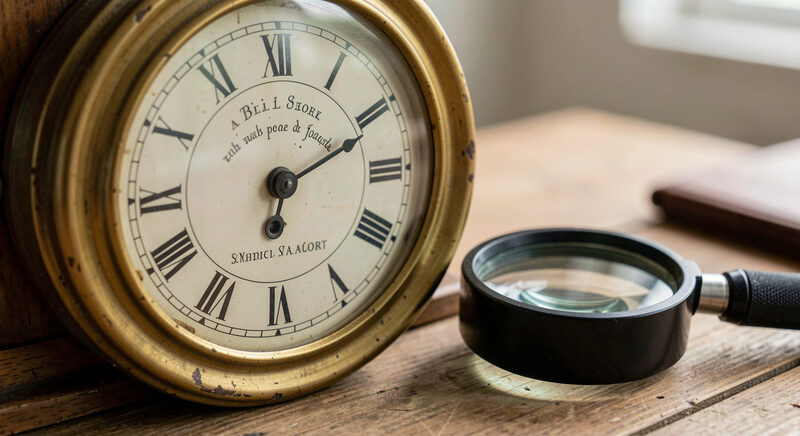
The dial is the first thing to read because it is the most visible and often the most datable. Look at the numerals. Early dials carry Roman numerals with a distinct way of writing four and nine. Later dials move to Arabic numerals, and the style of the figures themselves changes with fashion. Look at the hands, which were replaced often and whose shape can pull a clock later than its case. Look at the signature or name on the dial, which can name a maker or a retailer, though a retailer's name does not always mean the retailer made the clock.
Look also at the decoration of the dial and any painted scene on it. Painted dials belong to particular periods and regions, and their subjects, from ships to buildings to figures, follow the taste of the time. A dial repainted in a later century will carry a later style, which is a useful clue in itself.
Then the movement
The movement is the heart of the clock and the part that dates it most honestly, because movements were rarely updated. The type of escapement, the shape of the plates, the way the wheels are cut and the arrangement of the striking work all point to a period and a school of making. A movement made by hand, with plates that are not quite symmetrical and wheels cut by an early method, is older than one made with machine cut parts and regular spacing.
The way the clock is powered also dates it. Weight driven movements belong to the long tradition of the tall case clock, while spring driven movements allowed smaller clocks to be made and belong to a later, wider market. The key, the winding squares and the layout of the barrel are all readable clues. A collector who cannot read a movement should at least note what it does, whether it strikes, chimes or runs silently, and whether it is weight or spring driven.
The case, and the trap of the case
The case speaks about the fashion of furniture rather than the mechanics of time. Its wood, its proportion, its feet and its mouldings place it in the history of furniture, and a case can be older or newer than the movement inside it. A fine movement in a plain later case, or a modest movement in a grand early case, are both common, and neither is automatically a fault. The problem comes when a case has been cut down, widened or repainted to fit a movement it never held.
The trap of the case is that it is the easiest part to alter and the easiest part to fake. A new case can be made to look old with stain and wear, and an old case can be rebuilt from parts of several clocks. Look for the join between the movement and the case: whether the seat board fits, whether the dial sits flat, whether the hood closes without force. A clock that has grown into its case reads differently from one that has been forced into it.
Marks, labels and patents
Marks and labels are the confirmation, not the proof. A paper label inside a case, a stamped name on a movement, a patent date on a dial or a trade mark on a back plate can all place a clock precisely, and they should be photographed and recorded when found. But marks can be added, labels can be moved from one clock to another, and a famous name on a dial can sit above a movement from another workshop.
The safest use of a mark is to compare it with the rest of the clock. If the dial, the movement and the case all point to the same period, a mark that agrees with them is a strong confirmation. If the mark disagrees with everything else, it is worth asking why, and the answer is often that the clock has been assembled from parts. Patent dates are useful because they set a floor: a clock carrying a date cannot be older than that date, though it may be much later.
The features that mislead
Some features are famous for misleading collectors. The presence of a maker's name is not proof that the maker made the whole clock. A striking clock is not automatically older than a silent one. A large clock is not automatically early. A clock with a beautiful dial is not automatically valuable, because the dial may be the newest part of it. A clock that runs well is not automatically original, because a rebuilt movement can run better than an old one.
The cure for all of these is the same: read the parts against each other and trust the agreement rather than any single feature. A clock whose dial, movement and case tell one story is a clock a collector can date with some confidence. A clock whose parts tell different stories is a clock to buy only with open eyes, as a project or a curiosity.
When to ask for help
Some clocks are beyond the reading of a general collector, and there is no shame in that. A clock with an unsigned movement, an altered case and a repainted dial may need the eye of someone who has handled hundreds of them. Photograph the dial, the movement, the back plate and any mark, and show the photographs to a specialist before spending a large sum. The antique clocks guide on this site sets out the families of clocks, and How an Antique Clock Is Restored explains what a restorer does with the movement once it has been dated. Together the three pages give a collector a working method for the first clock and every one after it.