Smalls and Sporting
Carrying Antiques by Car: Packing, Loading and the Marks a Trip Leaves
How to pack, load and drive fragile antiques in a car, from clocks and lamps to china, and what to do about a scratched bumper after a buying trip.
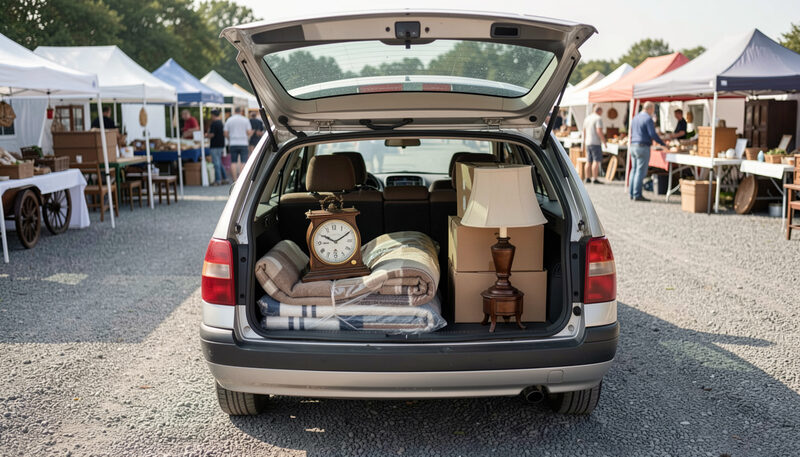
What is the safest way to load antiques into a car?
The safest load is one that cannot move. Antiques are rarely damaged by the weight of the trip; they are damaged by motion, when a lamp base slides into a stoneware jug on the first hard stop. Before anything goes in, the collector decides where each piece will ride and how it will be held there, then loads in the reverse order of unloading. The last piece in is the first piece out.
Heavy and compact objects ride lowest. A cast iron doorstop, a boxed set of flatware or a pair of bookends belongs on the floor behind the front seats, wedged with folded blankets so that it cannot tip. Tall objects such as a lamp with a glass shade or a vase travel upright and strapped between softer cargo, never lying loose across the back seat. Flat objects such as framed prints, tin signs and trays are best slid on edge between two layers of cardboard and held against the seat back.
What happens to the car on a buying trip?
A buying trip is hard on the vehicle as well as on the cargo. Collectors park in crowded fields beside flea markets, back into narrow lanes at estate sales and open doors beside walls and other cars while their arms are full. On a trip along the French coast the same thing happens in tighter streets, and a scraped bumper or a dented door is the kind of damage that tends to surface only when the antiques come out. A body shop such as Carrosserie du Garlaban in Allauch looks at photos of a scratched bumper or a dented door and calls back with a free quote from photos, which lets a traveler get a figure before deciding whether to repair the car now or later.
The practical habit is to photograph the car before the first stop and again after the last one, in daylight, from all four sides and at the corners. Photographs taken in raking light show shallow dents that a flat view hides. A traveler who has a dated record of the car at the start of the trip can tell a new mark from an old one, and can describe the damage clearly to whoever has to price it.
How should fragile objects be wrapped?
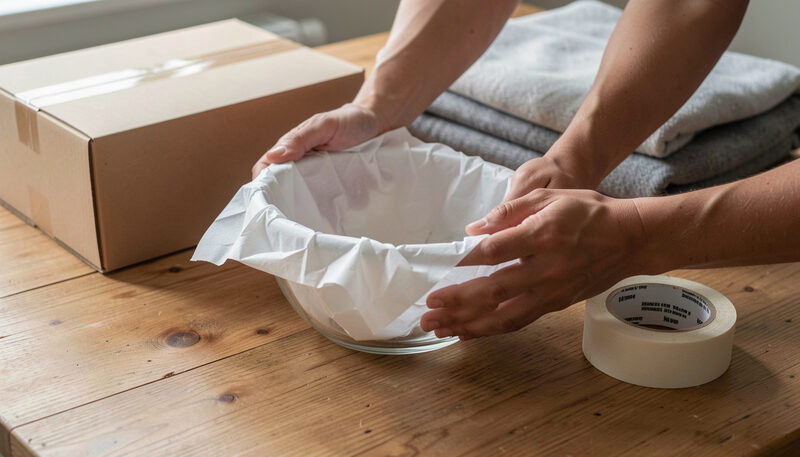
Wrapping works in three layers, and each layer has a different job. The first layer touches the object and must be clean, soft and free of dyes: acid-free tissue, unbleached muslin or a plain cotton cloth. Newsprint is a common choice at the estate sale, but its ink can mark unglazed porcelain, bare metal and old paper, and it is better kept for the outer filling than for the skin of the wrap.
The second layer is cushion. Bubble wrap, foam sheets or a thick folded blanket absorb the knocks of the road. The cushion should be thick enough that the object cannot be felt through it when pressed with a thumb. The third layer is the container: a box, a crate or a plastic bin that holds the shape and keeps one wrapped object from pressing on another. A box with a few inches of empty space around each item and a layer of soft filling at the bottom survives a bad stretch of road far better than a tight box with no give.
The Library of Congress publishes guidance on the care, handling and storage of collections at its preservation pages, and its core rule applies to every car trip: handle an object as little as possible, and always support it from underneath rather than by a handle, a rim or an arm.
Which antiques need special care in a car?
Clocks are the most common victims. A tall case clock travels with its weights and pendulum removed and wrapped separately, and the movement is secured so that the works cannot swing. The same rule holds for a shelf clock, which should never ride with its pendulum free to knock against the case. The restoration guide on how antique clocks are restored explains why a bent pendulum rod or a loosened dial is expensive to fix.
Glass and china need a different kind of attention. Pressed glass chips along its edges, so each piece is wrapped separately and boxed upright with filling around the rim. Porcelain with a gilded edge loses its gold if it is stacked without a layer of tissue between plates. Painted porcelain, including the Nippon pieces described in the guide to reading a Nippon backstamp, should travel in a box that is labeled on the lid so that it is not stacked under anything heavy at the other end.
Lamps with leaded or slag glass shades travel with the shade removed and wrapped on its own, because a shade is held by its own weight and a jolt can crack a joint in the metal came. Tins and trade signs travel flat, with the printed face protected by a clean sheet, since the paint on old tin chips on contact with anything gritty.
Does heat or weather change how antiques travel?
It does. A parked car in summer reaches temperatures that soften wax, loosen old glue and warp thin veneer, and a trunk packed tightly against the rear window can become an oven by early afternoon. A collector who stops for lunch parks in shade, cracks a window and keeps fragile cargo off the rear shelf and out of direct sun. In cold weather the opposite risk applies: a piece of glass or porcelain moved from a freezing car into a heated room can crack from the sudden change, so it should warm up slowly in its wrapping.
Rain is a quieter hazard. Paper, textiles and unsealed wood absorb moisture quickly, and a wet cardboard box loses its strength. Plastic bins and a sheet of plastic over the load protect against a sudden shower, and a few silica gel packets in the box help with condensation on a humid day.
How can the load be secured on the road?
Straps, blankets and the shape of the cargo area do the securing. Cargo straps anchored to the tie-down points hold tall pieces upright. Blankets between boxes stop sliding. A cargo net over the top layer keeps small boxes from jumping on a rough patch of road. Anything placed on the passenger seat should be belted in or wedged, because a car that brakes hard turns a loose box into a projectile.
Speed matters as much as strapping. Collectors who drive slowly on gravel lanes and country roads, and who brake early, deliver their finds in better condition than those who rely on padding alone. Rest stops are a useful moment to check the load: open the back, look for shifted boxes, and retie anything that has loosened.
Is a van or a larger vehicle worth renting?
For a single clock or a pair of lamps, an ordinary car with the rear seats folded down is enough. For a full dresser, a set of chairs or a bulky mantel clock, a van with a flat floor and tie-down rails is a better choice, and the cost is usually smaller than the cost of repairing a piece that was forced into a car too small for it. Measuring the piece and the cargo opening before the sale avoids the awkward moment at the curb when the object will not go in.
A last check before leaving the sale pays for itself. Walk around the car, look at how the load sits, and ask a seller for an extra blanket or a roll of tape if anything looks insecure. Most sellers at estate sales and flea markets have seen enough loading to be generous with both.
Should antiques ride in the trunk or the back seat?
Either can work. The back seat keeps cargo within sight and out of the heat of a closed trunk, while a trunk with a flat floor holds boxes more firmly. Heavy pieces belong low and against a seat back, and fragile pieces belong wherever they can be held upright and padded on every side.
Is newspaper acceptable for wrapping antiques?
Newspaper works as filling around a wrapped object, but it should not touch porcelain, metal or paper directly because the ink can transfer. Acid-free tissue or plain cotton cloth belongs against the object.
What should be photographed before a buying trip?
The car, from all four sides and at the corners, in daylight. A dated set of photos taken before and after the trip shows any new mark clearly and makes a repair quote easier to request.