Smalls and Sporting
Antique Fly Fishing Tackle
Collect bamboo fly rods, reels and creels: what makes a rod collectible, how to check ferrules and guides, and how to store them.
Why fly fishing tackle is collected
Fly fishing tackle is collected for three reasons at once. It is beautiful, because a split cane rod and a brass reel are objects of fine workmanship. It is usable, because a well kept rod can still be fished. And it is documented, because the great makers of rods and reels left marks, catalogues and records that allow an object to be dated and placed. Few fields combine those three so completely.
The collector is drawn to the tackle of the late nineteenth and early twentieth centuries, when rod making reached a high point and when the sport spread from a small circle to a wide public. The objects of that period are the ones most often found, and the ones with the most reference material behind them.
Reading a bamboo fly rod
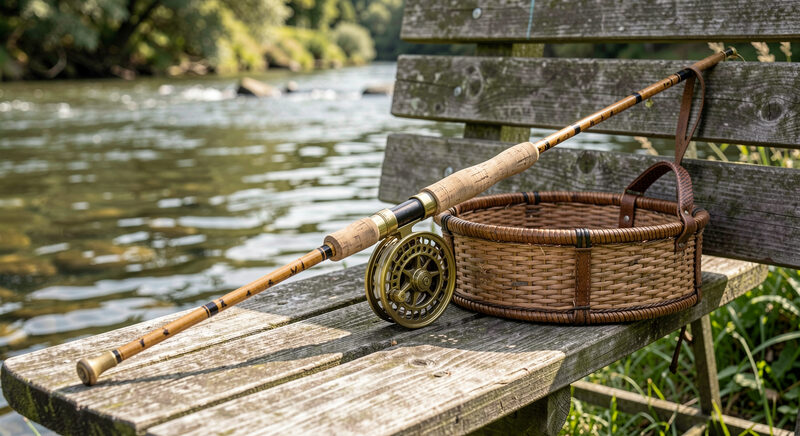
A split cane, or bamboo, fly rod is built from strips of cane glued together into a tapering shaft, with ferrules joining the sections and guides carrying the line. The quality of a rod lies in the cane, the taper, the glue and the fittings, and each of those can be read. Look at the cane for the straightness of the grain and for the absence of dark spots, which mark a fault in the material. Look at the ferrules, which join the sections, for a tight fit and for the maker's mark. Look at the guides, which carry the line, for wear and for replacement.
The taper of a rod is the shape of its power, and it is the hardest thing for a collector to judge without casting the rod. A rod that is too stiff or too soft for its line weight is a rod that will not fish well, however good its cane. The collector who intends to fish a rod should match it to a line and try it, and the collector who intends only to display it should still know its line weight, because that is part of what the rod is.
Reading a reel
The classic fly reel is a simple machine of a spool, a frame and a foot that fits the rod. It may be single action, turning once for each turn of the handle, or multiplying, turning several times. It may have a click check, a drag or no check at all. The quality of a reel lies in the fit of its parts, the sound of its check and the honesty of its finish.
Look at the reel's foot, which fits the rod, for wear and for a fit that is not too loose. Look at the spool for a wobble, which tells of a bent spindle or a worn bearing. Look at the check, which should sound clean and even, and at the handle, which should turn without binding. Look for a maker's mark on the frame or the foot, and for the small differences in finish that separate an early reel from a later one. A reel that has been polished to a shine has lost the surface that carried its age, and with it some of its value.
Creels, nets and the smaller tackle
The creel, a woven basket that carried the catch, is the most fragile of the classic objects and the most evocative. Early creels were woven from willow or cane, often with a leather strap and a hinged lid, and their condition depends on how they were stored. A creel that has dried out cracks and loses its weave, so it should be kept in moderate humidity and away from heat. Nets, rod cases, fly wallets and boxes of flies complete the field, and each is read by the same method: material, construction, wear and marks.
Flies themselves are collected, and old flies in their original wallets are a small field of their own. They are read by their hooks, their materials and the names of the patterns, which often carry the name of the angler or the river that made them famous.
Dating a rod by its marks
Marks are the quiet part of tackle collecting and often the most useful. Rod makers stamped their name, their town and sometimes a serial number on the butt, on a ferrule or on a reel seat, and those marks place a rod within the working life of a firm. Reel makers marked the frame, the foot or the back plate, and a reel with a clear mark and its original finish is worth more than the same reel polished bright. Where a mark is absent, the taper of a rod and the construction of a reel still carry the dating, and the collector who records what is known about each piece builds a reference that serves for every later purchase.
Storage and care
Tackle needs to be stored as tackle, not as decoration. A rod should be kept in its case or in a cloth sleeve, straight or in its sections, away from heat and from damp. A reel should be kept dry and its moving parts lightly oiled, but never over oiled, since oil attracts grit. A creel should be kept out of the sun and away from dry heat. A net should be kept flat so that its hoop does not set into a curve.
Photograph each piece with its marks before storing it, and record what is known about it, so that the record survives even if the object is later sold. The smalls and sporting guide on this site sets out the whole field of small objects and country gear, and the page on collecting Victorian hatpins shows how the same careful reading is applied to another family of smalls. Together they give a collector a method that works on a reel, a hatpin or a bottle alike.