China, Glass and Porcelain
Nippon and Noritake Porcelain
Read Nippon and Noritake backstamps, date a service by its mark, and judge gilding, damage and completeness before buying.
What Nippon and Noritake mean
Nippon is an older name for Japan, and it was used on export porcelain made for the Western market in the late nineteenth and early twentieth centuries. The mark Nippon told the buyer where the piece was made, and it covered a wide range of wares, from simple everyday services to heavily decorated pieces with raised gold and painted scenes. Noritake is the name of a company that grew out of that export trade and became one of the best known makers of Japanese porcelain for the Western table.
The two names are often used together because the marks overlapped. A piece may carry the word Nippon, the word Japan, the name Noritake, or a combination, and the change from one mark to another is the main tool for dating. The collector who learns the sequence of marks can place a piece within a few years, which is far more useful than knowing the name alone.
Reading the backstamp
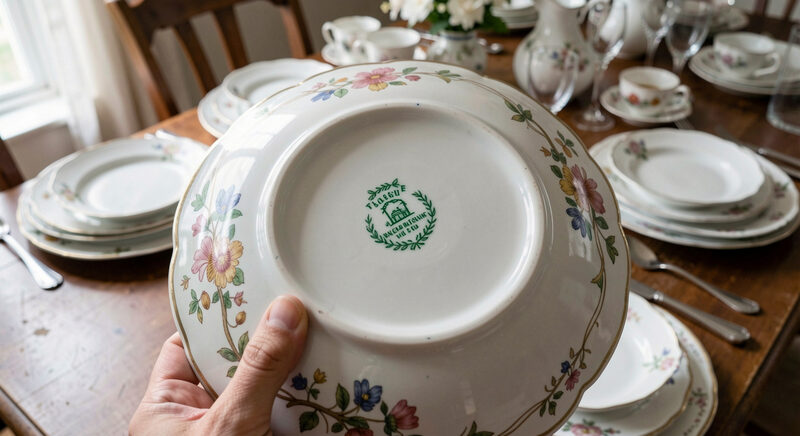
The backstamp is the mark printed or stamped on the base of a piece, and it is the first thing to turn over and read. Look at the words it uses, the colours it uses and the way it is applied. Early marks tend to be hand painted or stamped in a single colour, often green or blue, with the word Nippon and a wreath or a simple device. Later marks introduce the name Noritake, sometimes with the word Japan, and often with a more formal design of a wreath, a crown or a circle.
The colours of the marks are a dating signal in themselves. Green and blue are common in the early period. Maroon and other colours appear later. A mark printed in a colour that belongs to a different period from the decoration of the piece is a reason to look closely, since a mark can be added and a piece can be decorated later. The safest reading is to compare the mark with the body, the glaze and the pattern, and to want them to agree.
Dating a service by its mark
Because the marks changed with the rules of trade and the practice of the maker, they can be used as a rough calendar. Pieces marked with the older name for Japan belong to the earlier export period. Pieces marked with the maker's name and the country belong to a later period. Pieces with a pattern name, a number or a retailer's name belong to the years when the trade was organised through importers and department stores.
A collector does not need to memorise every mark. It is enough to know that the words and the colours form a sequence, and to check a suspect mark against a reference before buying an expensive service. Where the mark is faint or worn, the decoration and the shape of the pieces carry the same information, and the two together usually settle the question.
Decoration, gilding and raised work
The decoration of Nippon and Noritake ware is part of its appeal and part of its fragility. Many pieces carry gilding applied over the glaze, and raised gold work that stands proud of the surface. This gilding wears with use and with washing, and a service that has lost its gold along the rims is worth less than one that has kept it. The collector should look at the gilding on the most used pieces, since that is where wear appears first, and should check that any remaining gold is the original and not a later touch up.
The painted decoration deserves the same care. A hand painted scene is more valuable than a printed one, and the difference can be seen in the way the paint sits on the surface and in the slight variation between pieces of the same set. A set whose pieces are identical in every brush stroke was printed rather than painted. A set with small differences between the pieces was decorated by hand, and those differences are a mark of quality rather than a fault.
Following a pattern or a period
A collector can follow a single pattern or a single period, and both are rewarding. Following a pattern means collecting the pieces of one design, from the teapot to the plates, and learning how the design changed across the years it ran. Following a period means collecting the ware of a short span of years, whatever the pattern, and learning to recognise the body, the glaze and the decoration of that time. Either way, the collector should keep a note of the mark on each piece, since a file of marks is what turns a shelf of china into a reference the collector can trust.
Condition and completeness
Condition decides the value of a service more than its mark or its pattern. Porcelain chips at the rim, cracks along the base and crazes where the glaze has shrunk away from the body. Hold each piece to a strong light to find the hairline crack that the eye alone will miss. Run a finger along the rim and the foot. Look at the gilding for wear and at the painted areas for losses. A repair that has been painted over is the hardest fault to find, and the most expensive to discover after the sale.
Completeness is the second question. A service was made with a fixed set of pieces, and a set that has lost its teapot or its celery dish is harder to complete than one that is simply small. The collector who wants a set should learn the names of its pieces before buying, and should carry a piece of the set as a sample when completing it, so that colour and pattern can be compared directly. The china, glass and porcelain guide on this site sets out the whole field, and the page on Victorian and pressed glass covers the glass that shared the same table. Together the three pages give a collector a working method for the porcelain service and for everything around it.