China, Glass and Porcelain
Victorian and Pressed Glass
Identify Victorian and pressed glass patterns, tell early pressed from later moulds, and check for chips, cloudiness and repairs.
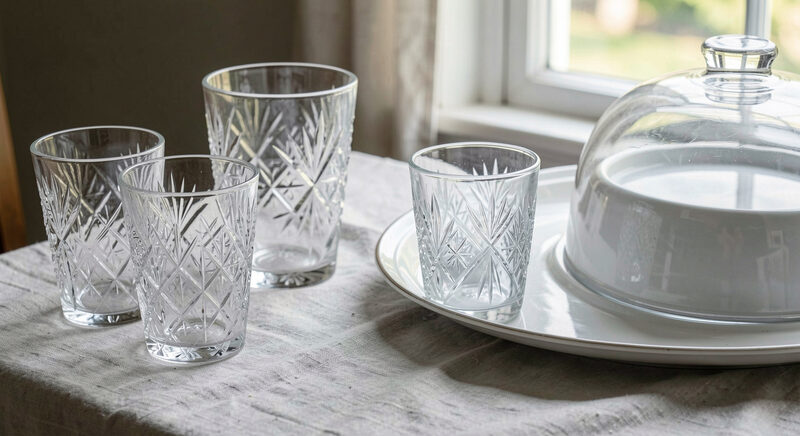
How pressed glass was made
Pressed glass is made by pressing a gather of hot glass into a metal mould, which gives the piece its shape and its pattern at the same time. The method was developed to bring the look of cut glass to a wider market, and it did so at a fraction of the cost. A mould could be used many times, and a single pattern could be produced in clear glass, in coloured glass and in a range of sizes, which is why one pattern often exists in many versions.
Because the pattern comes from the mould, it carries the marks of the mould. A pressed piece shows the crisp edges and the sharp detail that hand work cannot repeat, and it shows a seam where the two halves of the mould met, usually on the sides or along the foot. These marks are not faults. They are the signature of the method, and they are the first thing a collector learns to look for.
Telling early pressed from late
The earliest pressed glass, made when the method was new, tends to be heavy and its patterns bold. It was pressed in simple moulds, and the glass was often thick and full of small bubbles. As the method improved, the glass became lighter, the patterns finer, and the colours more varied. Later pressed glass, made in the twentieth century, is lighter still, and its patterns are often simpler and more regular.
The weight of a piece in the hand is a quick guide. An early tumbler feels solid and a little uneven. A later one feels light and uniform. The colour of the glass is a second guide, since early pressed glass was often clear or a soft blue, while later glass was made in a wider range of colours. The pattern itself is a third guide, because patterns ran for a limited number of years and their popularity can be dated from catalogues and reference books.
Patterns and pattern names
Pressed glass is collected largely by pattern, and patterns have names, some given by the makers and some given by collectors long after the fact. A pattern may be named for a flower, a fruit, a place or a person, and the name is a shorthand for a whole family of pieces made in the same mould. Collectors who choose a pattern to follow will find that the field opens up, because a single pattern may include dozens of shapes, from tumblers and goblets to butter dishes and covered compotes.
Patterns also divide into periods. A pattern that ran in the middle of the nineteenth century looks different from one that ran at the end of it, and the two do not mix well on the same table. A collector building a set should choose one period and one pattern, and should carry a sample piece when buying, so that the new piece can be compared for colour and for the fineness of the pattern.
Reading condition in glass
Glass is beautiful and unforgiving, and its faults are permanent. Chips appear on rims, on feet and on the edges of handles. Cracks begin at a chip or at a point of stress and spread slowly over years. Cloudiness, sometimes called sickness, comes from years of washing in hot water and from the action of detergents, and it cannot be polished away without removing the surface of the glass.
The collector should read every piece by touch as well as by sight. Run a finger along the rim to feel a chip. Turn the piece over and look at the foot, where chips are common. Hold it to the light to find the fine crack that runs across the base. Feel the inside of a tumbler for the roughness that marks cloudiness. A chip on the foot of a piece that will stand on a shelf is a small matter. A crack across the base of a piece that will hold water is a reason to leave it behind.
Reproductions and reissues
Pressed glass was reproduced almost as soon as it was collected. Old moulds were reused, new moulds were made from old patterns, and later makers copied the most popular designs. A reproduction is often lighter than the original, its pattern is a little softer, and its colour is a little different. Some reproductions are marked, and some are not. The collector who knows the weight and the feel of an early piece will spot a later copy at once, and the collector who does not should buy the cheapest examples until the eye and the hand have learned.
Storing and using pressed glass
Pressed glass can be used, and it is happiest when it is. Wash it by hand in warm water with a mild soap, and dry it at once, since the dishwasher is the enemy of old glass. Store it where pieces do not touch, or place a cloth between them, so that rims and feet do not chip against each other. Keep it out of direct sun, which can fade coloured glass, and away from sudden changes of temperature, which can crack it.
The china, glass and porcelain guide on this site sets out the families of tableware and the reading of marks, and the page on Nippon and Noritake porcelain covers the porcelain that shared the same table. Read all three, and a table set from a country auction becomes a collection with a history rather than a pile of dishes.